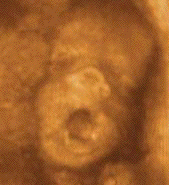
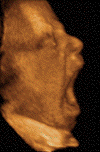
- Fetal
yawning : a behavior's birth with 4D US
revealed
- Bâillements
du foetus: la naissance d'un
comportement
révélée
par l'échographie
4D
-
- Abstract : The capacity of
four-dimensional sonography to evaluate complex
facial expressions allows recognition of a
common behavior, yawning. Although there has
been remarkably little interest in yawning in
research and medical practice, even though it is
an everyday phenomenon, we submit an original
interpretation on the basis of knowledge derived
from phylogeny and ontogeny. As a flip-flop
switch, the reciprocal interactions between
sleep- and wake-promoting brain regions allow
the emergence of distinct states of
arousal.
-
- By its ontogenical links with REM sleep,
yawning appears as a behavior which procures an
arousal reinforcement through the powerful
stretch and the neuromuscular rewiring induced.
Yawning indicates a harmonious progress in the
development of both the brainstem and the
peripheral neuromuscular function, testifying to
the induction of an ultradian rhythm of
vigilance. The lack of fetal yawn, frequently
associated with lack of swallowing, associated
or not with retrognathia, may be a key to
predict a brainstem's dysfunction after birth.
(en
français) JIOG
2007
-
Abadie
V Développement de la face: face et
séquence de Pierre Robin Compte-rendu du
5° congrès de médecine
foetale 2000
- De Vries
JIP, Visser GHA, Prechtl HFR. The emergency
of fetal behavior. Qualitative aspects. Early
Hum Dev 1982;7301-22
- Egerman
RS, Emerson DS. A fetal yawn. N Engl J Med
1997;335(20):1497
- Fraser
AF The phenomenon of pandiculation in the
kinetic behaviour of the sheep fetus. Appl
Anim. Behav. Sci., 1989;24:169-182
- Giganti, F., M.
J. Hayes, et al Yawning and behavioral
states in premature infants Dev Psychobiol 2002;
41; 3; 289-296
- Hata T,
K Kanenishi, et al Real-time 3-D sonographic
observation of fetal facial expression J Obstet
Gynaecol Res 2005;31(4):337-340
- Holditch-Davis
D et al Development of behaviors in preterm
infants: relation to sleeping and waking Nursing
Research 2003;52(5):307-317
- Kanenishi
K, Hanaoka U, Noguchi J, Marumo G, Hata T.
4D ultrasound evaluation of fetal facial
expressions during the latter stages of the
second trimester. Int J Gynaecol Obstet.
2013
- Kim
TH, Lee JJ, et al. Efficacy of assessment in
fetal behaviour by four dimensional
ultrasonography. J Obstetrics Gynaecology
2010;30(5):439-443
- Kurjak
A, Azumendi G, et al Fetal hand movements
and facial expression in normal pregnancy
studied by four-dimensional sonography J.Perinat
Med. 2003;31:496-508
- Kurjak
A, Azumendi G, et al The potential of 4D
ultrasonography in the assessment of fetal
awareness J Perinat Med 2005; 33; 46-53
- Kurjak
A, M Stanojevic et al Behavioral pattern
continuity from prenatal to postnatal life a
study by four dimensional (4D) ultrasonography J
Perinat Med 2004;32:346-353
- Masuzaki H
Color Dopplerimaging of foetal yawning
Ultrasound in obstetric & gynecolgy
1996;8(5):355-6
- McManus
B, Devine P, Brandsetter RD A fetal yawn? N
Engl J Med 1997;336:1329-30
- Peirano
P, Algarin C, Uauy R Sleep-wake states and
their regulatory mechanisms throughout early
human development J Pediat 2003;143(4S):S70-79
- Petrikovsky BM,
Kaplan GP, Pestrak H The application of
color Doppler technology to the study of fetal
swallowing Obstet Gynecol 1995;86:605-8
- Petrikovsky
B, Kaplan G, Holsten N Fetal yawning
activity in normal and high-risk fetuses: a
preliminary observation. Ultrasound Obstet
Gynecol 1999;13(2):127-130
- Piontelli
A. Fetal Yawning in Development of Normal
Fetal Movements. The fisrt 25 weeks of
gestation. Spinger. 2010. 135p.
- Reissland
N, Francis B, Mason J. Development of Fetal
Yawn Compared with Non-Yawn Mouth Openings from
24-36 Weeks Gestation. Plos One.
2012;7(11):e50569
- Roodenburg
PJ et al Classification and quantitative
aspects of fetal movements during the second
half of normal pregnancy Early Human Development
1991;25:19-35
- Sepulveda W,
Mangiamarchi M Fetal yawning. Ultrasound
Obstet Gynecol 1995;5:57-9
- Sherer DM,
Smith SA, Abramowicz JS Fetal yawning in
utero at 20 weeks gestation. J Ultrasound Med
1991;10:68
- Stefanski
M et al A scoring system for states of sleep
and wakefulness in term and preterm infants
Pediatric research1984;18(1):58-63
- Van Woerden
EE, Van Geijn HP, Cazon FJM, van der Valk AW,
Swarties JM, Arts NFT. Fetal mouth movements
during behavioral states 1F and 2F. Eur J Obstet
Gynecol Reprod Biol 1988;29:97-105
- Walusinski
O, Kurjak A, Andonotopo W, Azumendi G Fetal
yawning assessed by 3D and 4D sonography The
Ultrasound Review of Obstetrics & Gynecology
2005;(3):210-217
- Walusinski
O. Fetal Yawning in Sonography Edited by:
Kerry Thoirs. Chapter 18 Pages 325-332
- Yan
F, Dai SY, Akther N, Kuno A, Yanagihara T, Hata
T. Four-dimensional sonographic assessment
of fetal facial expression early in the third
trimester. Int J Gynaecol Obstet.
2006;94(2):108-113
- Yigiter
AB, Kavak ZN. Normal standards of fetal
behavior assessed by four-dimensional
sonography. J Matern Fetal Neonatal Med.
2006;19(11):707-721
-
- Yawning
and behavioral states in premature
infants
- Giganti,
F., M. J. Hayes, et al Dev Psychobiol 2002;
41(3); 289-96
-
- In human adults, yawning bas been related
to a change in activity or arousal state
and is, therefore, tied to CNS arousal
modulation. Yawning is a precocious behavior
that is observed sporadically in fetuses as
early as 12 to 14 weeks of gestational age. No
changes in the incidence of yawns between 20 and
36 weeks of gestational age have been observed
in the fetus. In full-term infants, yawns were
reported on the first day of life. In the only
study to describe neonatal yawning in some
detail, Wolff (The development
of behavioral states and the expression of
emotions in early infancy ; 1987; University
Chicago press) observed that infant yawns
occur mainly near, or possibly anticipating, the
onset of sleep. State II sleep follows yawning
with a mean latency of 7 min. The present study
examined yawning during very early postnatal
development in relation to contextual behaviors
and spontaneous alterations in behavioral state
of premature infants borned between 30 et 35
weeks post-conceptual age.
-
- Chez l'homme adulte, le bâillement
apparait lors des changements
d'activités et de niveaux de
vigilance. C'est un comportement
précoce qu'il est possible de distinguer
dès 12 à 14 semaines de vie
foetale. Aucune variation de fréquence
des bâillements n'est notée entre
20 et 36 semaines de grossesse. Des
bâillements sont notés chez les
nouveaux-nés à terme au cours du
premier jour de vie. Dans la seule étude
publiée, Wolff (The
development of behavioral states and the
expression of emotions in early infancy ; 1987;
University Chicago press) note que les
bâillements de nouveau-nés à
terme apparaissent essentiellement à
l'approche de l'endormissement. Le sommeil de
stade II suit les bâillements avec une
latence de 7 mn. Le travail
présenté ici étudie les
bâillements et les comportements
associés avec d'éventuels troubles
de la vigilance, pendant les premiers jours de
vie chez des prématurés nés
entre 30 et 35 semaines.
-
Development
of behaviors in preterm infants:
- relation
to sleeping and waking
- Although both nurse, clinicians and
researchers use infant behaviors to indicate the
responses of preterm infant to stimulation,
little is known about how the biological factors
of development, sleeping and waking states,
infant characteristics, and infant illness
severity affect preterm infant behaviors.
-
- The study of Diane
Holditch-Davis examined the development of
eight infant behaviors (yawn,
sigh, negative facial expression, startle/jerk,
jitter, large body movement, mouth movements,
hiccup, sleeping and waking states) over
the preterm period and determined the relation
of these behaviors to sleeping and waking and to
infant characteristics and illness severity.
Seventy-one preterm infants were observed from 7
to 11 pm weekly from the time they were no
longer critical until term or discharge. The
occurrence of four sleep-wake states and eight
behaviors were recorded every 10-seconds during
the observations.
-
- Negative facial expressions increased over
the preterm period and sighs, startle/jerks,
jitters, and the likelihood of having hiccups
decreased. Infant characteristics had only minor
effects: boys had more negative facial
expressions, and longer mechanical ventilation
was associated with more sighs and jitters. All
behaviors showed state-related differences in
frequency. In addition, only startle/jerks and
jitters showed the same developmental patterns
within each state.
-
- Significant development of infant behaviors
occurs over the preterm period but involves
changes not only in the absolute percentage of
each behavior but also in the percentages within
each sleeping and waking state. Thus, preterm
infant behaviors can not be used clinically for
assessment without consideration of the state in
which they occur.
-
- Evolution
des comportements chez les
prématurés:
- relation
avec le sommeil et
l'éveil
- Bien que les puéricultrices, les
cliniciens comme les chercheurs jugent les
réponses comportementales à
diverses stimulations chez les
prématurés et les nourissons, peu
de connaissances sont validées afin de
savoir quels facteurs de développement
modifient les comportements des
prématurés (états
d'éveil et stades de sommeil) tant chez
l'enfant sain que malade.
-
- L'étude conduite par Diane
Holditch-Davis passe en revue huit
comportements infantils (bâillement,
cri, expressions faciales douloureuses,
sursaut/secousse, peur, grand déplacement
du corps, mouvements buccaux, hoquet,
éveil et stades de sommeil)
pendant la période de
prématurité et détermine la
relation de ces comportements avec
l'éveil et le sommeil chez le
bébé sain et malade, en fonction
de la sévérité de son
atteinte. 71 prématurés ont
été observés de 19 à
23 heures, chaque semaine, dès que leur
état n'était plus critique juqu'au
terme théorique ou la sortie de
pouponnière. L'occurence des 4 stades de
sommeil et des 8 comportements étaient
colligés toutes les 10 secondes pendant
chaque période d'observation.
Alors que les expressions faciales
douloureuses augmentent de fréquence, les
cris, les sursauts, les éveils et le
hoquet se raréfient pendant la
période de prématurité. Les
caractéristiques individuelles de chaque
enfant ont des effets mineurs: les
garçons ont plus d'expressions faciales
douloureuses; une ventilation mécanique
prolongée est corellée à
plus de cris et de peurs. Chaque comportement a
une fréquence propre à chaque
stade d'évolution. A noter que seuls les
sursauts et la peur présentent les
mêmes aspects développementaux
à chaque stade évoutif.
-
- Des évolutions significatives des
comportements ont lieu dans la période de
prématurité; ces changements ne
concernent pas uniquement la fréquence
respective de chacun, mais aussi la
fréquence de chacun par rapport aux
différents niveaux d'éveil et des
stades du sommeil.
-
- En conclusion, les comportements des
prématurés doivent être
cliniquement évalués, non
seulement en eux mêmes, mais aussi en
fonction des états d'éveil au
cours desquels ils apparaissent.
  -
|