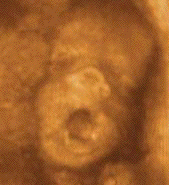
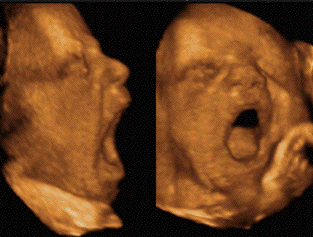
The description of fetal yawning activity
has been limited to case reports. Sherer
and associates' described yawning movements in a
20-week fetus. Sepulveda and Mangiamarchi
reported repetitive yawning movements in a
27-week fetus over a 7-min observation period.
In both cases, yawning activity was detected
incidentally. We report our observations of
yawning activity in 38 fetuses between 36 and 40
weeks of pregnancy, performed as a part of a
fetal behavior study protocol.
METHODS
Of the 38 fetuses studied, 16 were
appropriately grown and were products of healthy
pregnancies (Group 1). The remaining 22 fetuses
were products of high-risk pregnancies: nine of
Rh-immunized mothers and 13 growth-restricted
fetuses (Group 2). Fetal growth restriction was
diagnosed when estimated fetal weight was :9 10%
below the norm for gestational age. Gestational
age was established in the first trimester on
the basis of crown-rump length (CRL)
measurements. All rnothers were referred for
fetal assessment, including a biophysical
profile, for the following indications:
decreased fetal movernents, previous stillbirth,
suspected postmaturity, fetal growth
abnormalities and Rhimmunization. Studies were
performed in the postprandial state at 09.00 and
12.00 in a quiet room with the woman in the
lateral recumbent position. All ultrasound
examinations were performed using a 3.5-MHz
Acuson 128 XP curvilinear probe. Fetal lips,
mouth, tongue, pharynx, larynx, tracheal and
esophagus were surveyed in serial coronal and
sagittal planes.
All fetal mouthing movements were analyzed
by a review of the videotape in slow motion.
Yawning was definedas a prolonged wide opening
of the mouth followed by a quicker closure of
the mouth. All neonates in both normal and
high-risk pregnancy groups were born in
satisfactory condition. The 1- and 5-min Apgar
scores were greater than 7 and 9, respectively,
in all cases. Rh-iminunized fetuses had
significant anemia (hematocrit between 17 and
28) and required in utero blood transfusions.
The diagnosis of restricted fetal growth was
confirmed postnatally. Cord blood pH was
analyzed in all fetuses in Group 2. A paired t
test was utilized for statistical comparison of
groups.
RESULTS
Yawning activity was detected in 18 of 22
fetuses in Group 1 during 60 min of observation.
The fetal face in either coronal or sagittal
view was visualized during 75-90% of the
observation time. In most cases, a fetal yawn
was an isolated event and consisted of a slow
opening of the mouth with simultaneous downward
movement of the tongue. This phase occupied
50-75% of the yawning cycle (between 9 and 13
s). After reaching its maximum opening, the
mouth remained wide open for 2-8 s (20-45% of
the yawning cycle) and immediately returned to
its initial position (5-10% of the yawning cycle
or 1-2 s). Growth-restricted fetuses
demonstrated yawning patterns consisting of
isolated yawns, similar to those seen in healthy
fetuses.The number of yawning movements over a
60mn observation period was 5±4 in normal
fetuses, 8±5 in growth-restricted fetuses
and 12±6 in anemic fetuses. Unusual bursts
of fetal yawning activity were recorded in
anemic fetuses. These bursts were characterized
by clusters of three or more yawns, with the
temporal characterisfics of isolated yawns
described above.
DISCUSSION
In neonates and adults, a yawn consists of
an involuntary wide opening of the mouth, with
maximal widening of the angle of the jaw, long
and deep air inhalation through the mouth and
nose and a slow expiration. This is a
brainstem-mediated reflex that serves to reverse
relative hypoxia. Drowsiness and attendant
decreased mentalactivity, which are associated
with this borderline hypoxia are also reversed
by yawning. Yawning occurs with loss of interest
(boredom) and may or may not be associated with
fatigue. Pathological yawning in children and
adults may have a hormonal or neurological
basis.
De Vries distinguished the flowing types of
fetal mouth movement: (1) jaw opening; (2)
Yawning; (3) Sucking. In addition to these
patterns, Van Woerden observed grimace and
tongue protrusion movements. Most of these
movernents were detected during behavioral
states 1F (quiet sleep) and 2F (active sleep).
The fetal mouthing movements were similar to
those observed in neonates. Fetal yawning has
been observed as early as 11 weeks of pregnancy,
and most fetal yawning activity occurs during
active sleep. None of the previously reported
cases-of fetal yawning were associated with
fetal hypoxia. Sepulveda and Mangiamarchi
reported yawning in a 27-week healthy fetus and
speculated that it may serve as a mechanism to
protect against alveolar collapse in
extrauterine life by expanding alveoli with
inspired fluid during intrauterine life.
We observed yawning in healthy and high-risk
fetuses. Studies of fetal yawning activity were
performed as part of a protocol to study fetal
behavior using a standard set-up (morning hours,
quiet room, lateral recumbent position of the
patient. The results of the first part of this
study dealing with fetal swallowing have been
published elsewhere.
Fetal yawning was a sporadic activity in the
majority of fetuses studied, and this is in
agreement with previous studies. Clusters of
yawning activity were observed in our series in
anemic fetuses. Although yawning should have no
effect on P02 in intrauterine life as it does
postnatally, it may change intrathoracic
pressure, and thereby increase venous return to
the heart. For this reason, the occasional
yawning practiced by a normal fetus may be a
compensatory mechanism in an anemic fetus.
Although a yawn is easily identified as such
by observation of neonates or adults, the
ultrasonographic identification of a yawn by a
fetus has been called into question. McManus
speculated that the image 'A fetal yawn',
published in the New England journal of
Medicine, may represent a single long-lasting
opening of the mouth or a set of repetitive
openings of the mouth lasting for 4-6 s and
unrelated to yawning activity~ We agree that a
single image is not enough to identify a
particular pattern of behavior as a fetal yawn.
However, if complex movements such as yawns are
reliably identified in neonates, it is
reasonable to assume that qualitative
observational criteria can also be applied to
fetuses to identify and characterize yawning.
Continuous prolonged observation is necessary
for proper identification and characterization
of fetal yawning. Our initial experience with
studying fetal yawning activity in healthy and
abnormai fetuses is a descriptive study of a
preliminary nature. One of the obvious problems
with such a study is that one cannot be certain
that all fetal mouthing movements are recorded;
when the fetal is in the occiput anterior
position the fetal face cannot be visualized
adequately. Second, the large standard deviation
for all three groups requires further study of
larger numbers of hypoxic fetuses to ascertain
whether observed differences between normal and
abnormal patterns of yawning are
significant.