
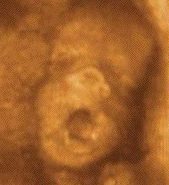
autres bâillements
foetaux
|
- mise à jour
du
- 28 févier
2026
- PLoS
One
- 2026;21(2):e0341339
|
- Fetal
yawning and mouth openings:
- Frequency,
developmental trends,
- and
association with birth weight
- Menin D, Veronese P, Gervasi MT, Oster H,
Dondi M.
|

|
- Tous
les articles consacrés au
bâillement
foetal
- Fetal
yawning: all
publications
-
- Fetal
yawning frequencies were negatively related with
birth weight
-
- During the last 15 years, the brain cooling
hypothesis has shown unparalleled explanatory
and predictive power among the several attempts
aimed at elucidating the phylogenetic origins of
yawning. However, some blind spots remain which
are not directly accounted for by this
theoretical explanation, including the presence
of yawning in human fetuses, as their
thermoregulation is largely dependent on the
mother. However, the few studies which addressed
fetal yawning are often plagued by serious
methodological issues, in particular concerning
the validity and reliability of methods adopted
to identify yawns, resulting in contradictory
results.
-
- In the present study, the authors scored
yawns and other mouth openings in 32 healthy
fetuses observed during ultrasonographic scans
between the 23rd and the 31st gestational week,
using the Baby FACS-based System for Coding
Perinatal Behavior (SCPB). We found average
yawning frequencies to be below 5 per hour, and
not related with gestational age (GA).
Non-yawning mouth openings, instead, showed a
GA-related decrease that, together with validity
issues of measurement methods, might explain the
similar developmental trend found for yawning
frequencies in two previous studies. Finally,
yawning frequencies were negatively related with
birth weight, considered as an indicator of mild
distress, potentially showing a stress-related
modulation of yawning behavior in healthy
fetuses.
-
- La
fréquence des bâillements
était négativement
corrélée au poids à la
naissance
-
- Au cours des 15 dernières
années, l'hypothèse du
refroidissement cérébral a
démontré un pouvoir explicatif et
prédictif sans précédent
parmi les différentes tentatives visant
à élucider les origines
phylogénétiques du
bâillement. Cependant, certaines lacunes
subsistent qui ne sont pas directement prises en
compte par cette explication théorique,
notamment la présence de
bâillements chez les fœtus humains,
dont la thermorégulation dépend
largement de la mère. Cependant, les
quelques études qui ont abordé le
bâillement fœtal sont souvent
entachées de graves problèmes
méthodologiques, notamment en ce qui
concerne la validité et la
fiabilité des méthodes
adoptées pour identifier les
bâillements, ce qui donne lieu à
des résultats contradictoires.
-
- Dans la présente étude, les
auteurs ont évalué les
bâillements et autres ouvertures de la
bouche chez 32 fœtus en bonne santé
observés lors d'échographies entre
la 23e et la 31e semaine de gestation, à
l'aide du système Baby FACS pour le
codage du comportement périnatal (SCPB).
Nous avons constaté que la
fréquence moyenne des bâillements
était inférieure à 5 par
heure et qu'elle n'était pas liée
à l'âge gestationnel (AG). Les
ouvertures de la bouche autres que les
bâillements ont, en revanche,
montré une diminution liée
à l'AG qui, associée aux
problèmes de validité des
méthodes de mesure, pourrait expliquer la
tendance similaire observée dans deux
études précédentes en ce
qui concerne la fréquence des
bâillements. Enfin, la fréquence
des bâillements était
négativement corrélée au
poids à la naissance,
considéré comme un indicateur de
détresse légère, ce qui
pourrait indiquer une modulation du comportement
de bâillement liée au stress chez
les fœtus en bonne santé.
- Introduction
- Yawning is a phylogenetically and
ontogenetically primitive behavioral pattern,
virtually ubiquitous to vertebrates [1,2),
which is observed in human fetuses since the
11"h gestational week [3] and unchanged
throughout life [4].
-
- The fact that yawning frequencies have been
found to be modulated by a vast range of
conditions and stimuli, including but not
limited to stress (5.6), hunger [Z.8],
pain (9), arousal [10] and
thermoregulation [11], has probably
contributed to the proliferation of theories
about this behavior's potential functions and
phylogenetic origins. In particular, despite the
interest that this peculiar behavior has
generated in scholars throughout history
[12], up until a few decades ago this
fascination manifested itself mostly in terms of
theoretical speculations and yawning was
generally considered as a mechanism to revert
hypoxia, despite the lack of empirical evidence
supporting this hypothesis (13].
-
- Starting with the 1980s, however, a new
interdisciplinary interest towards yawning has
risen, leading to a considerable accumulation of
evidence regarding the conditions and factors
that modulate yawning behavior, as well as the
neuropharmacological processes involved, and to
the formulation of several hypotheses aimed at
explaining these evidences in terms of
evolutionary functions [14,15].
-
-
- The popular opinion according to which
yawning is a respiratory maneuver aimed at
increasing oxygenation and/or decrease CO2
levels of blood was thoroughly tested and
rejected by Provine et al. [13], who
found that neither exercise nor experimentally
manipulated O2 or CO2 levels in the blood had
any effect on yawning frequencies.
-
- During the following decades, the
interdisciplinary interest toward yawning has
risen, leading to the formulation of several
hypotheses about the ultimate causes of this
behavioral pattern. In particular, different
scholars have proposed several modulating
factors as an expression of the original
function of yawning, including state change
[16,17), arousal regulation [18],
cortisol levels and stress regulation
[19], empathy and social interactions
[20,21] and brain thermoregulation
(22].
-
- Although these hypotheses are still proposed
and argued for as alternative explanations by
some scholars [21,23], in the last 15
years, the brain cooling hypothesis, according
to which the phylogenetically original function
of yawning lies in its ability to regulate brain
temperatures, has been gaining notable empirical
support. This perspective offers a potentially
unifying explanation for much of the evidence
related to different yawning modulation
mechanisms [11,24]. In fact, the brain
cooling hypothesis is not only corroborated by
evidence pertaining to the conditions and
mechanisms involved in yawning modulation, but
has been substantiated with data showing that
the behavioral pattern involved in yawning
actually produces the effect hypothesized, i.e.,
reducing brain temperatures when the
environmental temperature allows it
[25]. It is important to note, however,
that evidence of this modulation is currently
available only for rats [25],
budgerigars [26] and mice [27), and
additional studies are needed to confirm these
results in other species. This thermoregulatory
function of yawning has also been plausibly
explained based on the circulatory changes
accompanying yawning episodes in all homeotherms
[11,28]. In general, a striking number
of predictions based on the brain cooling
hypothesis were later confirmed, based on
observational and experimental data, e.g.,
regarding the thermal window where yawning is
more often observed [29], the positive
correlation between yawn duration, brain size
and neuron numbers across mammals and birds
[2] and the modulation of yawning
Icontagion due to neck temperature manipulation
[30].
-
- Moreover, advocates of the brain cooling
hypothesis have been able to more parsimoniously
account for an impressive amount of evidence
originally presented in the context of other
theoretical frameworks. In fact, many proximate
causes for yawning can be explained in terms of
an underlying thermoregulatory function,
including state changes, stress and drug-induced
modulation [11,24).
-
- Overall, to the best of our knowledge,
despite the ongoing discussion, the brain
cooling hypothesis has shown unparalleled
explanatory and predictive power among the
several attempts aimed at elucidating the
phylogenetic origins of yawning and at tracing
back different forms of modulation to a singular
core function. However, some blind spots remain
which, albeit not necessarily falsifying the
brain cooling hypothesis, are not directly
accounted for by this theoretical explanation,
at least in its original or current forms.
-
- The most widely investigated and discussed
of these blind spots concerns contagious
yawning, a phenomenon which has been observed in
some highly social species, including humans and
several other primates, dogs, captive wolves and
pigs [21,24]. In particular, although
the contagiousness of yawning has been explained
in terms of it being a cue providing information
about the reduced alertness of the yawner,
rather than a communicative signal [24,31),
some (albeit limited) evidence seems to indicate
that familiarity, empathy and/or emotional
contagion might play a role in facilitating
yawning contagion (21]. The fact that
familiarity and emotional closeness seem to
increase the likelihood of yawning contagion has
therefore led to to the formulation of two
alternative hypotheses: the Attentional Bias
Hypothesis and the Emotional Bias Hypothesis.
The former considers the effect of familiarity
on yawning contagion as being mediated by the
time spent looking at the yawner's face and
attentional focus [32), while the latter
regards it as a direct effect of positive social
bonding [21,33] and, if confirmed, might
suggest that, at least for the species for which
yawning can be contagious, there are dynamics of
yawning modulation that can not be traced back
to brain thermoregulation. Interestingly,
proponents of the Emotional Bias Hypothesis
argue that yawning contagion might be an
exaptation of this plesiomorphic behavior to
facilitate emotional contagion (33]. This
would support the idea that this largely
conserved behavioral pattern could be serving at
least partially different evolutionary functions
across species.
-
- Another blind spot of the brain cooling
hypothesis is that it only applies to
homeotherms (11]. However, as Gallup himself
recognized [24], considering the
ubiquity of yawning among vertebrates, it is
likely that this behavior originally evolved in
jawed fish. This seems to indicate that the
thermoregulatory function of yawning may not
have been present at its phylogenetic origin,
and might be hypothesized to derive from one or
more more primitive functions. Yawning in fish
and other poikilotherms is still a vastly
understudied phenomenon, but a recent study has
found that white-spotted chars show higher
frequencies of yawning immediately before a
behavioral transition from stationary to active
(34], suggesting that the mechanism of
yawning modulation related to state changes can
be observed in species where it cannot (at
least, to the best of our knowledge) be
explained in terms of thermoregulation.
-
- Another phenomenon which eludes explanation
in terms of the brain cooling hypothesis is
fetal yawning. Because fetal thermoregulation is
largely, although not solely [35]
dependent on the mother, Walusinski [36]
has even argued that the brain cooling
hypothesis overlooks the very existence of fetal
yawning. However, as Gallup & Eldakar
[11] pointed out, this argument relies
on the assumption that any behavior that can be
observed in utero serves the same functions)
after birth.
-
- Nevertheless, similarly to the phenomena
related with contagious yawning and yawning in
poikilotherms, although the existence of fetal
yawning might well be compatible with the brain
cooling hypothesis, it is still a challenge that
should be addressed in order to pursue an
organic and systematic theory of the
phylogenetic and ontogenetic origins of yawning.
In particular, if similarly to what observed by
Yamada & Wada [34] in white spotted
chars, fetuses were to yawn in somewhat similar
conditions to homeotherms, this might indicate
that there is one or several more primitive
function(s) of yawning, or, alternatively, that
yawning somehow serves a thermoregulatory
function also in human fetuses and in
poikilotherms, as hinted at by Gallup &
Eldakar [11].
- Despite the theoretical relevance of this
topic in the context of yawning research,
however, fetal yawning is still somewhat
overlooked. This lack of attention is probably
due to the practical challenges inherent in
studying behavior in utero based on US scans,
often characterized by low spatial and temporal
resolution. Moreover, the few existing studies
have yielded somewhat contradictory results,
e.g., regarding the estimated yawning
frequencies across fetal development, ranging
from zero [37,38] to over
10(37,39,40] yawns per hour across the third
trimester of pregnancy.
-
- As Menin et al. [41] pointed out,
this variability is likely due to issues
regarding the validity and reliability of the
methods adopted in order to identify yawns. In
fact, most studies only employed a single coder
and therefore presented no estimate of
inter-rater reliability, while at the same time
adopting very concisely worded descriptions or
even video samples exemplifying the behavioral
pattern as observational measurement tools
[41]. One study [3Z), on the other
hand, adopted a method based on the temporal
dynamics of mouth movements, classifying as
yawns all of the mouth openings with an opening
phase longer than their closing phase. This
pioneering approach, which identified yawns
based on an objective timing-based criterion,
resulted in good reliability, but was later
showed to have very limited specificity
(resulting in a high number of false positives)
in a study [41] adopting a detailed
description based on Baby FACS [42] as
benchmark in a preterm neonate model. In
particular, Menin et al. [41] showed
that, while their method resulted in classifying
11.5% of mouth openings as yawns, the one
adopted by Reissland et al. [37), in line
with their original results, led to identifying
67.5% of mouth openings as yawns.
-
- These validity issues highlighted in the
method based on the opening-to-closing duration
ratio [37) raise some questions as to the
soundness of the findings of their study, first
of all the sharp decrease associated with
gestational age (GA) that authors of that study
found both in yawning and non-yawn mouth opening
frequencies. This doubt is even more relevant,
as the study by Reissland et al. [37) is one
of the few to investigate the fetal development
of yawning frequencies, and is relatively widely
cited as evidence that yawning may be used as an
index of fetal development 43-45].
-
- To the best of our knowledge, the result
regarding a supposed GA-related decrease in
yawning frequencies, was only partly replicated
by another study [46), where authors found
only a small correlation between GA and yawning
frequencies. This study, however, may suffer
from the same psychometric issues that were also
described by Kurjak et al. [47), as it
employed a single coder and used a relatively
generic description which, similarly to the
method based on the opening-to-closing duration
ratio (37), risks classifying far too many mouth
openings as yawns. Other studies [47-49) did
not find such an effect of GA.
-
- Research questions and
hypotheses
- The present study aimed at shedding some
light on one of the blind spots in the brain
cooling hypothesis, namely the one concerning
fetal yawning, by addressing the following
research questions:
- 1. (1). What are the average yawning
frequencies over the second and third trimester
of gestation, as estimated using valid and
reliable measurement methods?
- 2. (2). Can the sharp GA-related decrease in
yawning frequencies found by Reissland et al.
[37] and AboEllail et al. [46]
be confirmed using such measurement
methods?
- 3. (3). Can a similar developmental trend be
found for non-yawning mouth openings? Could this
trend explain the differences previously
attributed to yawning?
- 4. (4). Is the average duration of yawning
and non-yawning mouth openings associated with
GA or birth weight?
- 5. (5). Are fetal yawning frequencies
related with variables potentially associated
with yawning modulation in extra-uterine life
(e.g., stress-related variables)?
-
- In order to tackle this last issue, as our
aim was to investigate potential
non-pathological modulators of yawning rates,
instead of comparing high-risk and low-risk
fetuses as done, e.g., in Petrikovsky et al.
[50], we used birth weight as a
predictor of yawning and non yawning mouth
opening rates in fetuses that were later born
full-term and with a weight appropriate for
gestational age (AGA). Slightly low birth
weight, in fact, was found to be associated with
increased short-term and long-term morbility
[51] and increased stress
[52,53] and even higher risk of
cognitive impairments [54,55]. We
therefore considered that a slightly reduced
birth weight might be associated with moderate
distress during the third trimester of
pregnancy.
-
- We hypothesize that the median and mean
yawning frequencies in fetuses over the second
and third trimester are lower than 5 yawns per
hour (H1), similar to those observed in preterm
neonates [8,56], and do not decrease nor
increase with GA (H2). We also hypothesize that
non-yawning mouth openings show a GA-related
decrease, which, together with the use of
non-specific measurement methods, would explain
the developmental trend found by Reissland et
al. [37] for yawns (H3).
- Moreover, because the duration of a mouth
opening episode is one of the cues often adopted
to identify yawns, we hypothesize that the
average duration of non-yawning might show a
GA-related decrease (H4) which would partially
explain the effect found by Reissland et al.
[37]. Finally, we hypothesize that
yawning frequencies might be negatively related
with birth weight, considered as an indicator of
mild distress (H5).
-
- D iscussion
- This study aimed at addressing some research
questions relevant to the overall study of
yawning, as well as some specific to fetal
behavior.
-
- First, despite a high variability, which
might affect estimates especially when
considering small samples and relatively brief
observation times, our results confirmed that
the average frequency of yawning over the second
and third trimester of gestation is
significantly below five yawns per hour (see H1)
[8,48,56]. In particular, the median
frequency we found was around two yawns per
hour.
-
- This finding corroborates the hypothesis
that studies which reported higher frequencies
have likely used non-specific measurement
methods, resulting in the classification of many
non-yawning mouth openings as yawns. The
frequency we estimated is similar to that found
in preterm neonates [8], and was not
associated with GA (see H2). This, together with
the GA-related decrease we found for the
frequency of non-yawning mouth openings (see
H3), provides further evidence for the
hypothesis that the developmental trend
highlighted by Reissland et al. [37], as
well as the high frequencies they estimated at
the beginning of the third trimester of
gestation, are due to the adoption of a
non-specific method for identifying yawns among
mouth openings episodes [41].
Furthermore, the GA-related decrease we found
for the average duration of non-yawning mouth
openings (see H4), might have contributed to the
previous partial replication of this
developmental trend by AboEllail et al.
[46], as longer mouth openings, in
absence of a reliable coding method, might be
more likely to be erroneously classified as
yawns.
-
- Finally, we found a negative association
between yawning frequencies and birth weight
(see H5), which represents, to the best of our
knowledge, the first evidence of yawning
modulation in healthy fetuses. The fact that
high yawning frequencies were a predictor of low
birth weight may have some implication in terms
of fetal neurobehavioral assessment, potentially
allowing practitioners to anticipate slightly
problematic outcomes even for full-term
pregnancies within the physiological range for
birth weight, and potentially to predict
instances of slightly low birth weight.
Moreover, in terms of yawning research, this
result is particularly relevant, as it seems to
highlight a form of stress-related modulation
similar to the one observed in extra-uterine
life for humans and other homeotherm
species.
-
- Overall, these findings offer a picture of
fetal yawning as closer in frequency and
modulatory dynamics to extra-uterine yawning
than previously thought. In particular, fetuses
showed similar yawning frequencies to those
observed in neonates and infants, and
highlighted a seemingly stress-related
[5,64] modulatory mechanism (namely, the
negative association with birth weight). The
discrepancy between our findings and those of
previous studies [37,46], aligning with
the methodological concerns raised by Menin et
al. [41], underscores the importance of
a renewed attention towards the validity and
reliability of methods used to identify yawns,
especially but not exclusively in fetuses, where
limited ultrasound video quality can complicate
accurate identification.
-
- In terms of the overarching theoretical
discussion on the functions of yawning
throughout life and across different species,
the evidence regarding the relationship between
yawning frequencies and birth weight is
compelling but far from conclusive: the
seemingly stress-related modulation observable
in healthy fetuses, in fact, provided that it is
confirmed by later studies, might be due to some
original function ontogenetically and maybe also
phylogenetically preceding the thermoregulatory
one. Alternatively, this evidence might indicate
that yawning somehow serves a thermoregulatory
function even in fetuses, but it might even not
serve any evolutionary function and just
represent a byproduct of the thermoregulatory
function that can be observed after birth.
-
- It should be noted as a limitation that this
study did not employ experimental manipulation
or selective observation of fetuses under
specific conditions, and did not include
measures (e.g., maternal body temperatures or
fetal heart rate) that could be useful in
disentangling the effects of different
modulatory mechanisms, with particular regard
for the thermoregulation hypothesis. Moreover,
in order to maintain the sample homogeneous
enough in order for it to be as representative
as possible of the population of healthy
fetuses, high risk pregnancies were excluded,
making it impossible to confirm whether
different conditions associated with stress
levels might also be related with yawning
frequencies. Further studies are needed to
address these limitations, and confirm whether
our findings are actually indicative of a
stress-related modulation. Furthermore, the
limited statistical power afforded by the
relatively small sample of this study might have
resulted in an inability to detect subtle
developmental trends. Nonetheless, the results
allow us to rule out a sharp variation in
yawning frequencies within the considered GA
window.
-
- In summary, this study provides a
significant contribution to the field of fetal
behavioral research. By employing a rigorous and
specific coding method for identifying yawns
among general mouth openings, we have helped
clarify a long-standing methodological
misconception regarding both the developmental
trends and the true frequency rates of fetal
yawning. Our findings&emdash;showing a median
frequency of around two yawns per hour that is
stable across gestation and a negative
association between yawning frequency and birth
weight&emdash;strongly align fetal yawning with
the established behavioral patterns of neonates
and infants. This methodological rigor, combined
with the novel finding of a seeming
stress-related modulation in healthy fetuses,
makes this arguably the most robust assessment
of this phenomenon to date. These insights not
only open new avenues for the clinical
assessment of fetal neurobehavioral status but
also compel continuing evaluation of the
theorized functions of yawning across ontogeny
as well as phylogeny, suggesting the presence in
fetuses of a modulatory dynamic closer to
extra-uterine life than previously
understood.
|
|