-
- Sonography
-
- Edited by: Kerry Thoirs
-
- ISBN
978-953-307-947-9, Hard cover, 346
pages
- Publisher: InTech
- Publication date: February 2012
-
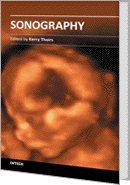
- Medical sonography is a medical imaging
modality used across many medical disciplines.
Its use is growing, probably due to its relative
low cost and easy accessibility. There are now
many high quality ultrasound imaging systems
available that are easily transportable, making
it a diagnostic tool amenable for bedside and
office scanning. This book includes applications
of sonography that can be used across a number
of medical disciplines including radiology,
thoracic medicine, urology, rheumatology,
obstetrics and fetal medicine and neurology. The
book revisits established applications in
medical sonography such as biliary, testicular
and breast sonography and sonography in early
pregnancy, and also outlines some interesting
new and advanced applications of
sonography.
-
- FETAL
YAWNING
-
- 1. Introduction
-
- The introduction of ultrasound exploration
during pregnancy has led to very important
conclusions concerning fetal behavioural
milestones. For example, the development of oral
sensorimotor functions such as swallowing
(essential for survival) can be assessed from
normal or abnormal neurobehavioral development
during the fetal period. While the assessment of
these functions takes a long time, another daily
behaviour can be detected during an ultrasound
examination: yawning. Before the development of
real-time imaging techniques, it was impossible
to assess facial movements, swallowing and thus
yawning. Only the overall movements of the trunk
and limbs could be perceived by the mother or by
someone touching her belly with their hand. In
this chapter, we will show the usefulness of
ultrasound in exploring facial mobility,
particularly yawning, and in drawing conclusions
on harmonious fetal cerebral development.
-
- The phenomenon of yawning is just as
intriguing and fascinating as sleep, yet
understanding of its causes and consequences has
defied the human mind for centuries.
Phylogenetically and ontogenetically primitive,
this motor behaviour has been remarkably well
preserved during evolution and is nearly
universal in vertebrates. It appears closer to
an emotional stereotypy than to a reflex.
Yawning is a stereotyped and often repetitive
motor act characterized by gaping of the mouth
accompanied by a long inspiration of air or
fluid, followed by a brief acme and a short
expiration. It is not merely a simple opening of
the mouth, but a complex coordinated movement
bringing together a flexion followed by an
extension of the neck, a wide dilatation of the
laryngopharynx with strong stretching of the
diaphragm and anti-gravity muscles. Highly
stereotypical because no environmental input
changes the sequence of movements, it is
observed in cold-blooded and warm-blooded
vertebrates, from reptiles with rudimentary
'archaic' brains to human primates, in water,
air and land environments. The ethology,
neurophysiology and neuropsychology literature
describes yawning as a transitional behaviour
associated with wake/sleep rhythms and
hunger/satiety fluctuations, where it
externalizes a group of possible
vigilance-stimulating mechanisms and attests to
the central role of the diencephalon and notably
the hypothalamus in homeostasis (Walusinski,
2004; Guggisberg, 2010).
-
- All the movements that a newborn is able to
produce originate during the fetal phase and are
performed throughout the life span. The fetus
exhibits a wide range of behaviours starting
with slow flexion and extension of the spine and
limbs at around 7 weeks gestation. The variety
of movements increases rapidly over the next
three to four weeks and many limb
flexion/extension, sucking and yawning (de
Vries, 1982).
-
- 2. How to recognize a fetal yawn during
ultrasound examination
-
- During ultrasound facial examination,
yawning can be seen accidentally. Yawning
consists of a slow opening of the mouth with
simultaneous downward movements of the tongue
and is usually combined with retroflexion of the
head. This phase occupies 50 to 75% of the
yawning cycle. After reaching its maximum
opening, the mouth remains wide open for 5 to 15
s and returns to its resting closed position
within seconds. This harmonious sequence is
markedly different from a brief swallowing
episode. Using a colour Doppler technique, it is
possible to observe the flow of amniotic fluid
through the fetal mouth, oropharynx and trachea
to the lungs. Contrary to adults, yawning is
non-repetitive in the fetus. It is part of a
generalized stretch, not just a matter of
opening one's mouth. It especially involves the
muscles of the respiratory tract (diaphragm,
intercostals), face and neck. Fetal yawning can
be recognized as one of the movement patterns
consistently present starting at around 11-12
weeks of pregnancy (fig. 2). The frequency of
yawning gradually increases between 12 and 24
weeks (fig. 3 and 4). During this time, it is
possible to observe 40 to 60 yawns per day, and
it is the best time to assess yawning with
ultrasound examination. A plateau is reached,
after which the number of yawns decreases
slightly until term. Thus, yawning occurs
regularly at a rate of about 1 to 3 yawns per
hour. It is obviously by chance or after a long
investigation that a yawn can be observed.
Furthermore, occiput anterior fetal position
unfortunately impedes adequate observation of
yawning (Sepulveda, 1995; Masuzaki, 1996).
-
- 3. Yawning and neurodevelopmental
assessments
-
- Yawning is a phylogenetically old,
stereotyped phenomenon. Its survival without
evolutionary variations suggests a particular
importance as far as development. The strong
muscular contraction during yawning has a
metabolically high cost. If we agree with
Darwin's evolutionary propositions, the costs of
brain activity must be outweighed by the
developmental advantages. Thus, one structural
hypothesis is activation of neurotrophins, which
leads to a cascade of new synapse formation or
recruitment as well as activation through the
diencephalon, brainstem and spinal cord.
Activity-dependent development has been clearly
shown to be one mechanism by which early sensory
or motor experience can affect the course of
neural development. This mechanism may be a
ubiquitous process in brain maturation, by which
activity in one brain region can influence
development of other regions. Fetal yawning can
be seen as a mechanism that influences
functional determination of the moving parts of
the musculoskeletal system and contributes to
joint development and maintenance.
-
- Fetal movements become more regular and
coordinated as a result of increased maturation
of the nervous system. At the beginning of the
third month, the embryo becomes a fetus with the
occurrence of the first oral and pharyngeal
motor sequences, controlled by neurological
brainstem development and the development of the
suction-swallowing activity and yawning. Indeed,
suction and yawning have the same embryological
origin, which shows the importance of the
brainstem in the neurophysiological development
of oropharyngeal activity coordinated by
respiratory, cardiac and digestive regulations,
which have the same neuroanatomical location.
The cephalic pole comprises an original
embryological encephalo-facial and
encephalo-cervical segmentation with a strict
topographical correspondence: the naso-frontal
and premaxillary structures are connected to the
forebrain; the maxillo-mandibular and anterior
cervical structures are connected to the 41
brainstem and its nerves. The major structures
of the brainstem are formed by the 7- 8th
postconceptional week, although brainstem
maturation continues until the 8th
postconceptional month. In addition to its many
subnuclei, the brainstem gives rise to a variety
of descending spinal motor tracts and hosts the
nuclei of five cranial nerves (VIIIXII).
-
- Formation of the pons begins almost
simultaneously, but its maturation is more
prolonged. The structures of the pons include
cranial nerves V-VIII and the medial which exert
widespread influence on arousal, including the
sleep-wake cycle. Therefore, these structures
exert tremendous influence on gross body
movements, head turning, heart rate, and
respiratory movements, as well as swallowing,
yawning, suckling, hiccups, and 7 facial
grimacing movements (Santagati, 2003; Kontges,
1996; Jacob, 2000; Sadler, 2009) (Fig. 1).
-
- The emergence of different behavioural
states is one of the most significant aspects of
early brain maturation in the fetus. In early
intra-uterine life, a diffuse collection of
phasic and cyclic motor events occur that
gradually coalesce. For the fetus, wakefulness
and sleep are reliably characterized,
respectively, by periods of myoclonic twitching
and movements of the limbs against a background
of muscle atonia. Periods of twitching are
almost always followed by the abrupt onset of
high-amplitude, wakeful behaviours. The
emergence of distinct states is followed by
dramatic changes in the level, duration and
cyclicity. An ultradian rhythm may be observed:
during a 60 to 90 minute period, there is an
alternation of movement characterized by motor
activity and movement characterized by rest, as
in newborns. The switchover from periods of rest
to periods of activity is accompanied by a yawn.
Thus, a periodicity of one or two yawns per hour
can be seen. Repetitive motions gradually
determine the shape and composition of moving
structures, as well as their associated neural
control pathways. The precociousness and
stability of yawning suggest that these
characteristics contribute to such development.
Furthermore, since a forced inspiration is a
critical component of yawning, a potential role
for expanding fetal terminal alveoli by the
inspired fluid is possible (Marder, 2005).
-
- 4. Yawning as a testimony to safe
neurological development
-
- In pregnant women, the methods of assessing
fetal wellbeing include the biophysical profile;
however, this method is limited. Thus, infants
must develop safe and effective respiration and
oral feeding skills after birth if they are to
survive. For this to occur, infantsmust have the
necessary anatomical structures and adequate
central control to coordinate swallowing,
ventilation, sleep and arousal. Yawning is
associated with all of these behaviours and thus
is useful to observe. Fetal facial expressions
and movements are known to be an indirect
expression of cerebral functional maturity
during the fetal period. Facial expressions
during this period correspond to facial
expression during the neonatal period.
Ultrasound has become essential for assessing
neurophysiological development as well as
detecting anatomical pathology. 4D ultrasound
makes it straightforward to comprehend
morphological dynamics such as yawning or
sucking. As we have seen, yawning can provide
information about neurodevelopment and the
development of behavioural rhythms (alternation
between motor activity, rest and sleep). When
fetal activity appears abnormal, nervous system
development may be disturbed. Yawning indicates
harmonious development of both the brainstem and
the peripheral neuromuscular function,
testifying to the induction of an ultradian
rhythm of vigilance (Rogers, 2005; Einspieler,
2005; Kurjak, 2008). (Ultradian rhythms are
recurrent periods or cycles repeated throughout
a 24-hour circadian day. In contrast, infradian
rhythms, such as the human menstrual cycle, have
periods longer than a day. The descriptive term
ultradian is used in sleep research in reference
to the 90&endash;120 minute cycling of the sleep
stages during human sleep).
-
- 5. Fetal pathologies assessed by yawning
exploration
-
- Yawns recur regularly, about one or two per
hour. When a yawn is observed during a 4D US
examination, it is obviously by chance or after
very long investigation. Yawning appears
preferentially after a period of rest, and
indicates waking. If normal swallowing is seen
(much more frequent), yawning seems of no
additional interest with regard to harmonious
brainstem maturation. Inversely, the lack or
dysfunction of swallowing requires taking the
time to understand the set of phasic and cyclic
motor events characterizing the ultradian fetal
rhythm, thereby increasing the opportunity to
observe a yawn. If the ultrasound examination
suggests the absence of yawning and swallowing,
it is imperative to search for developmental and
anatomical abnormalities (van Woerden,
1988).
-
- The lack of fetal yawning, frequently
simultaneous to the lack of associated
swallowing may be a key to predicting brainstem
dysfunction after birth. It is thus imperative
to search for mandibular hypoplasia and
glossoptosis, often associated with cleft palate
(Luedders, 2011; Palit, 2008). For example,
Pierre Robin sequence is characterized by a
posterior U-shaped cleft palate, retrognatia and
glossoptosis. Several arguments favour an
embryonic origin consisting of an anomaly in
caudal hind brain development. Feeding disorders
are the most important functional symptom.
Mother testimonies are consistent with the lack
of yawning at birth and its progressive
appearance during the first year of life,
simultaneous to the acquisition of the
swallowing reflex necessary for feeding. Pierre
Robin syndrome can be seen as the prenatal
brainstem dysfunction responsible for orofacial
maldevelopment, which can be diagnosed at 23
weeks gestation during a 4D ultrasound
examination (Bromley, 1994; Rotten, 2001).
-
- Petrikovsky et al. (1999) report that
clusters of yawns were observed in a series of
anaemic fetuses and suggest that yawning
repetitiveness helps to track fetal anaemia,
although fetal yawning has no effect on O2
pressure. Yawning can be seen as the
exteriorization of a homeostatic process, the
balance between adrenergic and cholinergic
stimulation of the autonomic nervous system. We
believe this function is already active in the
fetus. congenital pathologies in which yawning
research is relevant: - Mandibular hypoplasia is
a frequently encountered craniofacial difference
and can be classified into congenital and
developmental types: - Mandibulofacial
dysostosis with a variety of limb abnormalities
- Any syndrome (primary bilateral or unilateral
growth anomalies), associated or not with
temporo / mandibular joint ankylosis, aglossia /
microglossia: Francheschetti syndrome, Goldenhar
syndrome, Richner-Hanhart syndrome.
-
- - Moebius
syndrome comprises a congenital facial
diplegia and bilateral abducens nerve palsies by
degenerative and involved nuclei of the VI, VII,
and XII nerves. Simultaneous occurrence of limb
malformations with cranial nerve dysfunction
suggests a disruption of normal morphogenesis
during a critical period in embryonic brainstem
development, most likely starting at 4 to 7
weeks of gestation. Instances of bilateral
paresis of the soft palate and scattered
instances of dysphagia (some of which resolve in
infancy) have been reported. In this type of
functional problem, the inability to close the
mouth is constant.
-
- - Watershed infarcts in the fetal and
neonatal brainstem are clinically expressed as
multiple cranial neuropathies, failure of
central respiratory drive and dysphagia.
-
- - Goldenhar Syndrome includes malformations
primarily involving the jaw, mouth and ears and,
in most cases, affects one side of the body. It
represents defects in the embryonic first and
second brachial arches, the first pharyngeal
pouch and brachial cleft, and the primordia of
the temporal bone.
-
- - Joubert syndrome is a rare, genetic
disorder characterized by absence or
underdevelopment of the cerebellar vermis and a
malformed brainstem. The most common features
include ataxia, an abnormal breathing pattern,
sleep apnea, abnormal eye and tongue movements,
and hypotonia.
-
- - It is possible to complete this catalogue
by referring to Congenital trismus, Crisponi
syndrome, Stüve-Wiedemann syndrome,
etc.
-
- 6. Conclusion
-
- An entirely new paradigm has emerged in
fetal medicine, given that the advances in
prenatal imaging allow one to see and diagnose
disease not previously detected. Clinicians can
better plan for the delivery of the neonate,
with identified anomalies being optimally
managed and the impact on the neonate's health
minimized. There exists a sound rationale for
including systematic observations of spontaneous
motor activity in the neurological assessment of
fetuses. Yawning, as spontaneous motility linked
to brainstem activities, appears to be a good
parameter for indicating such wellbeing and
harmonious development. Thus, brainstem
maturation could be associated with changes in
the yawning pattern. A difficult task is
qualitative evaluation of general and partial
movements in order to distinguish normal from
abnormal performance. Yawning is a basic
behaviour that is easy to recognize and highly
valuable in assessing brainstem activity. It is
advisable to include the fetal yawning
examination in the systematic week 23 ultrasound
scan. Future studies will improve its diagnostic
value in detecting neuromuscular developmental
abnormalities as well as fetal behavioural
abnormalities.
-
-
- 7. References
-
- Bromley B, Benacerraf BR. Fetal
Micrognathia: Associated Anomonalies and
Outcome. J Ultrasound Med. 1994;13:529-533.
-
- de Vries JI, Visser GH, Prechtl FM. The
emergence of fetal behaviour. Early Hum Dey
1982;7:301-322.
-
- Einspieler C, Prechtl HF. Prechtl's
assessment of general movements: a diagnostic
tool for the functional assessment of the young
nervous system. Ment Retard Dev Disabil Res Rev.
2005;11:61-67.
-
- Guggisberg AG, Mathis J, Schnider A, Hess
CW. Why do we yawn? Neurosci Biobehav Rev.
2010;34:1267-1276
-
- Jacob J, Gutrhie S. Facial visceromotor
neurons display specific rhombomere origin and
axon pathfinding behavior. J Neuosci
2000;20:7664-7671.
-
- Kontges G, Lumsden A. Rhombencephalic neural
crest segmentation is preserved throughout
craniofacial ontogeny. Development
1996,122:3229-3242.
-
- Kurjak A, Tikvica A, Stanojevic M, Miskovic
B, Ahmed B, Azumendi G, Di Renzo GC. The
assessment of fetal neurobehavior by
three-dimensional and four-dimensional
ultrasound. J Matern Fetal Neonatal Med.
2008;21:675-684.
-
- Luedders DW, Bohlmann MK, Germer U,
Axt-Fliedner R, Gembruch U, Weichert J. Fetal
micrognathia: objective assessment and
associated anomalies on prenatal sonogram.
Prenat Diagn. 2011;31:1461-51.
-
- Marder E, Rehm KJ. Development of central
pattern generating circuits. Curr Opin
Neurobiol. 2005;15:86-93.
-
- Masuzaki H, Masuzaki M. Color Doppler
imaging of fetal yawning. Ultrasound Obstet
Gynecol l996;8:355-356.
-
- Palit G, Jacquemyn Y, Kerremans M. An
objective measurement to diagnose micrognathia
on prenatal ultrasound. Clin Exp Obstet Gynecol.
2008;35:121-123.
-
- Petrikovsky BM, Kaplan GP, Holsten N. Fetal
yawning activity in normal and high-risk
fetuses: a preliminary observation. Ultrasound
Obstet Gynecol 1999;13:127-130. Rogers B,
Arvedson J.Assessment of infant oral
sensorimotor and swallowing function. Ment
Retard Dev Disabil Res Rev. 2005;11:74-82.
-
- Rose RJ. Prenatal programming of behavior.
Neurosci Biobehav Rev. 2005;29:321-327.
-
- Rotten D, Levaillant JM, Martinez H., Ducou
le Pointe H, Vicaut E. The fetal mandible: a 2D
and 3D sonographic approach to the diagnosis of
retrognathia and micrognathia. Ultrasound Obstet
Gynecol. 2002;19:122-130.
-
- Sadler, T.W. Langman's Medical Embriology.
Williams & Wilkins, Baltimore. 2009. 414p.
Santagati F, Rijli F. Cranial neural crest and
the building of the vertebrate head. Nature Rev
Neurosci 2003;4:806-8l8.
-
- Sepulveda W, Mangiamarchi M. Fetal yawning.
Ultrasound Obstet Gynecol 1995;5:57-59. van
Woerden EE, van Geijn HP, Caron FJ, van der Valk
AW, Swartjes JM, Arts NF. Fetal mouth movements
during behavioural states 1F and 2F. Europ J
Obstet Gynecol Reprod Biol 1988;29:97-105.
-
- Walusinski 0, Deputte B. The phylogeny,
ethology and nosogeny of yawning. Rev Neurol
2004;l60:1011-1021.
-
- Yigiter AB, Kavak ZN. Normal standards of
fetal behavior assessed by four-dimensional
sonography. J Matern Fetal Neonatal Med.
2006;19:707-721.
-
-
-
-
|