AIM: To
investigate whether the same behavioral patterns
were present pre- and postnatally, and whether
there were any differences in the frequency of
movements observed in fetal and in early
neonatal life.
SUBJECTS AND METHODS: Ten out of 37
pregnant women in the third trimester of
pregnancy (median gestational age 34 weeks,
range 33 to 35 weeks) in the two-month period
(from November 1st to December 31st, 2003) were
enrolled in the investigation. Ten term,
appropriate for gestational age newborns (seven
born vaginally, three by elective SC, six girls,
six first-born) and were enrolled in the study.
All 4D examinations were performed on Voluson
730 (Kretztechnik, Zipt, Austria) and Acuvix
(Medison, Korea) with transabdominal 5 MHz
transducer. After standard assessment in 2D
B-mode ultrasound, a 4D mode was switched on and
live 3D image was reconstructed by selecting the
ideal representative 2D image placed in the
region of interest (ROI). The recordings of
neonatal behavior were made on the Sony P-612
OHMPL videotape by video camera (Sony Camcoder
CC DTRV 318 Hv8) and reviewed on the
videocassette recorder (Sony VHS SLV-N 900). The
median of newborns' age at the moment of
recording was 49 hours (range 4 to 112). During
the examination, newborns were lying in the bed,
separated from other infants in the nursery,
dressed, and lying on their backs in a supine
position with unrestrained hands. The
temperature in the room was 22 to 24 degrees C.
The video recording was performed mainly while
the children were actively awake or during alert
inactivity.
RESULTS: There
were no movements observed in fetal life that
were not present in neonatal life, while the
Moro reflex was present only in
neonates.
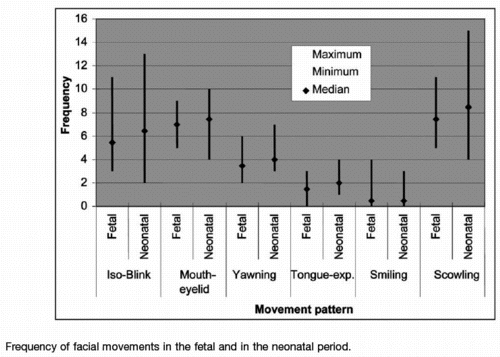
The most frequent fetal
and neonatal movements were scowling, eye and
mouth opening, and hand to face, hand to eye and
hand to head movements. Isolated blinking, mouth
to eyelid movement, yawning, tongue
expulsion and scowling were more frequent in
neonates than in fetuses, although the
difference was not statistically
signficant.
Hand to mouth movements
were more frequent in neonatal than in fetal
life while all other hand movements were less
frequent in neonates than in fetuses, although
the differences did not reach statistical
significance. Spearman rank order correlation
reached statistical significance in smiling
(R=0.71; t=2.91; P=0.02) and in hand to ear
movement (R = 0.80; t= 3.86; P = 0.005), and was
almost statistically significant in isolated eye
blinking (R=0.61; t=2.17; P =0.06), while the
correlations between the rest of the movements
were not statistically significant.
CONCLUSIONS: 4D
ultrasonography is a powerful tool in the
assessment of fetal behavior, and our study
showed that there is a continuity from fetal to
neonatal behavior, especially in terms of
isolated eye blinking movements, mouth and
eyelid opening, yawning, tongue expulsion,
smiling, scowling and hand movements directed to
other parts of the face.